






When summer gets tough: Understanding the link between heat and multiple sclerosis
Published Aug 3, 2026 • By Candice Salomé
For many people with multiple sclerosis (MS), the arrival of hot weather can turn simple everyday tasks into real challenges. Intense fatigue, heavier legs, visual disturbances, difficulty concentrating or walking… Some symptoms seem to suddenly “resurface” as soon as the temperature rises.
This sensitivity to heat is well known in MS. It can be a source of concern, especially when it gives the impression that the disease is progressing or that a new relapse is occurring. However, in most cases, this worsening is temporary and linked to a specific neurological phenomenon called Uhthoff's phenomenon.
Why does heat affect MS symptoms? Are all patients affected? And most importantly, how can you continue to live, work, go out, or travel when your body seems less able to tolerate high temperatures?
Find all the answers in our article!
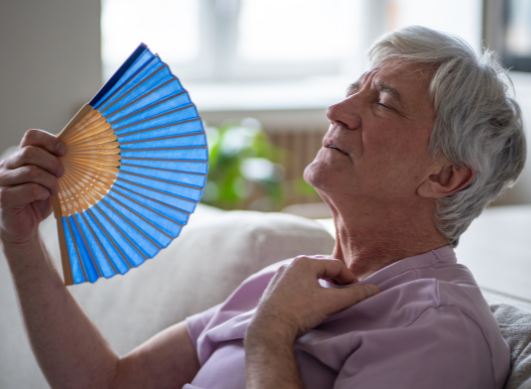
Why does heat affect MS symptoms?
A disease that disrupts the transmission of nerve impulses
In multiple sclerosis, the immune system attacks myelin, a protective sheath that surrounds nerve fibers. This myelin plays an essential role: it allows nerve signals to travel quickly and efficiently between the brain, the spinal cord, and the rest of the body.
When this sheath is damaged, nerve signals become more fragile. Even a slight increase in body temperature can further slow down this transmission and make certain symptoms more noticeable.
Uhthoff's phenomenon: a temporary worsening linked to heat
This phenomenon has a name: Uhthoff's phenomenon. First described in the late 19th century, it refers to a temporary worsening of neurological symptoms when body temperature rises.
This can occur during a heat wave, after a hot shower, physical exertion, a workout, or even during a fever. Symptoms generally subside once the body returns to a lower temperature.
It is important to note that this temporary worsening does not necessarily mean that a new lesion is developing in the nervous system.
Sensitivity varies greatly from person to person
Not everyone with MS reacts to heat in the same way. Some people report a significant worsening of their symptoms as early as the first days of summer, while others tolerate high temperatures relatively well.
This variability likely depends on several factors: the location of neurological lesions, pre-existing fatigue, level of physical activity, treatments, and the body’s ability to regulate its temperature.
Which symptoms may be exacerbated during hot weather?
Fatigue that is often more intense and sudden
Fatigue associated with MS is already one of the most common and disabling symptoms of the disease. Heat can significantly amplify this fatigue.
Some people describe a sudden feeling of exhaustion that is disproportionate to the effort expended. Simple activities like walking, cooking, or going outside for a few minutes can become much more difficult during hot weather.
More noticeable motor difficulties
Heat can also exacerbate difficulties with walking, a sensation of heavy legs, balance problems, or muscle weakness.
For some people, everyday activities become temporarily more complicated: climbing stairs, carrying objects, or standing for long periods may require more effort.
Visual and cognitive impairments
Uhthoff's phenomenon was first identified based on visual disturbances that worsened after physical exertion or exposure to heat. Blurred or double vision may thus temporarily recur in some people.
Heat can also exacerbate certain existing cognitive disturbances: difficulty concentrating, mental sluggishness, forgetfulness, or a feeling of “brain fog.”
Heat and MS flare-ups: how to tell the difference?
A temporary worsening isn’t necessarily a flare-up
When a symptom reappears or intensifies with heat, it’s common to fear a new flare-up. However, in many cases, it’s simply a temporary reactivation of old symptoms.
The main difference is that heat-related symptoms generally subside as the body cools down.
The role of context and duration
The context in which symptoms appear is often an important factor. A worsening of symptoms that occurs during a heat wave, after a hot bath, or following strenuous physical activity is more likely to indicate heat sensitivity.
Conversely, new symptoms, persistent symptoms, or symptoms that continue to progress without any exposure to heat may require medical evaluation.
A common source of anxiety for patients
Even if temporary, this worsening of symptoms can be psychologically difficult to cope with. Some people feel as though they are “taking a step backward” in their recovery or fear gradually losing their independence.
Over time, however, many learn to better identify their limits and the situations that exacerbate their symptoms.
How can you better cope with hot weather when living with MS?
Adjusting your daily routine without feeling guilty
During hot weather, certain adjustments can help minimize discomfort: scheduling activities during the coolest hours of the day, avoiding prolonged exertion, or staying in air-conditioned places whenever possible.
These adjustments don’t mean “giving up” on your activities, but rather learning to conserve your energy.
Cooling strategies
There are several ways to better cope with the heat: lightweight clothing, misters, fans, cold drinks, or cooling devices specifically designed for people with MS.
Some studies suggest that cooling techniques can temporarily improve fatigue and certain physical performance metrics.
Moving forward despite the disease
Heat sensitivity can change the way you plan your vacations, work, or certain social activities. However, many people with MS gradually find strategies that allow them to maintain an active life despite these limitations.
Learning to recognize your own reactions, anticipating certain situations, and accepting a different pace of life can help you regain a greater sense of calm over time.
FAQ – MS and heat
Why does heat worsen MS symptoms?
Because a rise in body temperature can slow down the transmission of nerve signals in areas where the myelin is already damaged.
Is Uhthoff's phenomenon dangerous?
No, it generally corresponds to a temporary worsening of symptoms related to heat.
Does heat trigger an MS flare-up?
Not necessarily. Heat-related worsening is often reversible once the body cools down.
Which MS symptoms are worsened by heat?
Fatigue, walking difficulties, muscle weakness, visual disturbances, and trouble concentrating are among the most common.
How can people with MS better cope with the heat?
Certain lifestyle adjustments and cooling strategies can help limit the impact of high temperatures.
If you found this article helpful, feel free to give it a “Like” and share your thoughts and questions with the community in the comments below!
Take care!
 Facebook
 Twitter