






Skin cancer: When a mole or spot is worth a closer look
Published May 24, 2026 • Updated Jun 9, 2026 • By Candice Salomé
A small spot that changes slightly. A mole that looks a little different. A wound that does not seem to heal.
At first glance, these signs may appear harmless. They are often overlooked, forgotten, or dismissed as normal changes in the skin.
Yet some skin cancers develop slowly and discreetly. Early detection often depends on noticing these subtle changes.
Understanding these warning signs, without becoming overly worried, can help you become more aware of your body and how it changes over time.
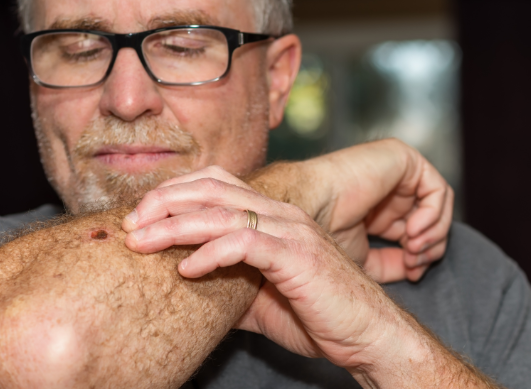
What is skin cancer?
Skin cancer refers to several types of tumours that develop from skin cells.
The most common are basal cell carcinoma and squamous cell carcinoma, which typically grow slowly, and melanoma, which is less common but potentially more aggressive.
These cancers are often linked to prolonged exposure to ultraviolet (UV) radiation, whether from natural sunlight or artificial sources.
They most commonly appear on sun-exposed areas of the body, but they can also develop elsewhere.
Why do some warning signs go unnoticed?
A disease that often develops gradually
Unlike some other conditions, skin cancers can develop slowly.
The changes are sometimes so gradual that they become difficult to notice in everyday life.
Symptoms are often dismissed
A pigmented spot or a small scab may seem insignificant.
Because the skin naturally changes over time, it can be difficult to distinguish between a normal change and something that deserves closer attention.
A lack of awareness
Many people are not sure which signs should raise concern.
This lack of awareness can delay the recognition of certain abnormalities.
Visible signs that should not be ignored
A mole that changes
A changing mole is often one of the first things that attracts attention.
Changes may involve its size, shape, colour, or borders.
An asymmetrical appearance, irregular edges, or uneven colouring are all features worth paying attention to.
An unusual spot
The appearance of a new spot on the skin, particularly one that changes over time, can also be a warning sign.
Some spots may darken, enlarge, or develop blurred or irregular borders.
A wound that does not heal
A lesion that persists, bleeds, or fails to heal properly is another sign that should not be overlooked.
This type of symptom is commonly associated with certain forms of skin cancer, particularly some carcinomas.
Unusual sensations
In some cases, an area of skin may become itchy, painful, or unusually sensitive.
Although these sensations are not specific to skin cancer, they can sometimes accompany suspicious lesions.
Melanoma: A special case
Melanoma is a type of skin cancer that can progress more rapidly than many other skin cancers.
It may develop from an existing mole or appear on previously unaffected skin.
To help identify suspicious changes, healthcare professionals often use the ABCDE rule, which highlights five visual features to watch for:
- Asymmetry
- Border irregularity
- Colour variation
- Diameter
- Evolution (change over time)
This approach can help structure self-observation, although it does not replace professional medical advice.
Everyday life and lifestyle factors
Skin cancer develops within a broader personal and environmental context.
Sun exposure, sun-protection habits, and skin type all influence risk, but none of these factors alone determines whether someone will develop the disease.
Some people develop skin cancer despite no obvious history of excessive sun exposure, highlighting the complexity of these conditions.
Between vigilance and anxiety: Finding the right balance
Paying attention to your skin can be helpful, but it can also cause worry.
The challenge is finding a balance between awareness and peace of mind.
Not every skin change is a sign of cancer, but some deserve attention.
Being able to identify and describe these changes can often help people better understand what they are seeing without jumping to worst-case conclusions.
Why is this issue still underestimated?
Despite public awareness campaigns, skin cancer is sometimes perceived as less serious or less urgent than other forms of cancer.
This perception may lead people to delay paying attention to visible warning signs.
Yet, as with many diseases, early detection can play an important role in outcomes.
Getting to know your skin better
Learning to observe your skin, recognise its normal features, and notice how it changes over time can help you identify unusual developments more easily.
Every person's skin is different, and there is no single model of what is "normal."
Developing this familiarity with your own skin often makes it easier to spot meaningful changes when they occur.
FAQ: Skin cancer
What are the first signs of skin cancer?
Early signs often include visible skin changes, such as a spot or mole that changes in appearance over time.
Is a changing mole always dangerous?
No. Many mole changes are harmless, but some may require closer attention and medical assessment.
Should I be concerned about a wound that does not heal?
A wound that persists over time may be worth monitoring, particularly if it does not heal or repeatedly bleeds.
Can skin cancer develop without sun exposure?
Yes. Although UV exposure is a major risk factor, skin cancer can sometimes occur without obvious excessive sun exposure.
Can skin cancer be prevented?
Certain behaviours, such as protecting your skin from UV exposure, can help reduce risk. However, no single measure can completely eliminate the possibility of developing skin cancer.
If you found this article helpful, feel free to give it a “Like” and share your thoughts and questions with the community in the comments below!
Take care!
 Facebook
 Twitter
Sources :
Garrison ZR, Hall CM, Fey RM, Clister T, Khan N, Nichols R, Kulkarni RP. Advances in Early Detection of Melanoma and the Future of At-Home Testing. Life (Basel). 2023 Apr 9;13(4):974. doi: 10.3390/life13040974. PMID: 37109503; PMCID: PMC10145469.
Caraviello C, Nazzaro G, Tavoletti G, Boggio F, Denaro N, Murgia G, Passoni E, Benzecry Mancin V, Marzano AV. Melanoma Skin Cancer: A Comprehensive Review of Current Knowledge. Cancers (Basel). 2025 Sep 5;17(17):2920. doi: 10.3390/cancers17172920. PMID: 40941017; PMCID: PMC12427887.
Harrington E, Clyne B, Wesseling N, Sandhu H, Armstrong L, Bennett H, Fahey T. Diagnosing malignant melanoma in ambulatory care: a systematic review of clinical prediction rules. BMJ Open. 2017 Mar 6;7(3):e014096. doi: 10.1136/bmjopen-2016-014096. PMID: 28264830; PMCID: PMC5353325.
Stătescu L, Cojocaru E, Trandafir LM, Ţarcă E, Tîrnovanu MC, Heredea RE, Săveanu CI, Tarcău BM, Popescu IA, Botezat D. Catching Cancer Early: The Importance of Dermato-Oncology Screening. Cancers (Basel). 2023 Jun 6;15(12):3066. doi: 10.3390/cancers15123066. PMID: 37370677; PMCID: PMC10296378.
Duarte AF, Sousa-Pinto B, Azevedo LF, et al. Clinical ABCDE rule for early melanoma detection. European Journal of Dermatology : EJD. 2021 Dec;31(6):771-778. DOI: 10.1684/ejd.2021.4171. PMID: 35107069.

1 comment